
Free Samples Under GST: A Marketing Strategy That Could Cost You Input Tax Credit
Jul 02, 2026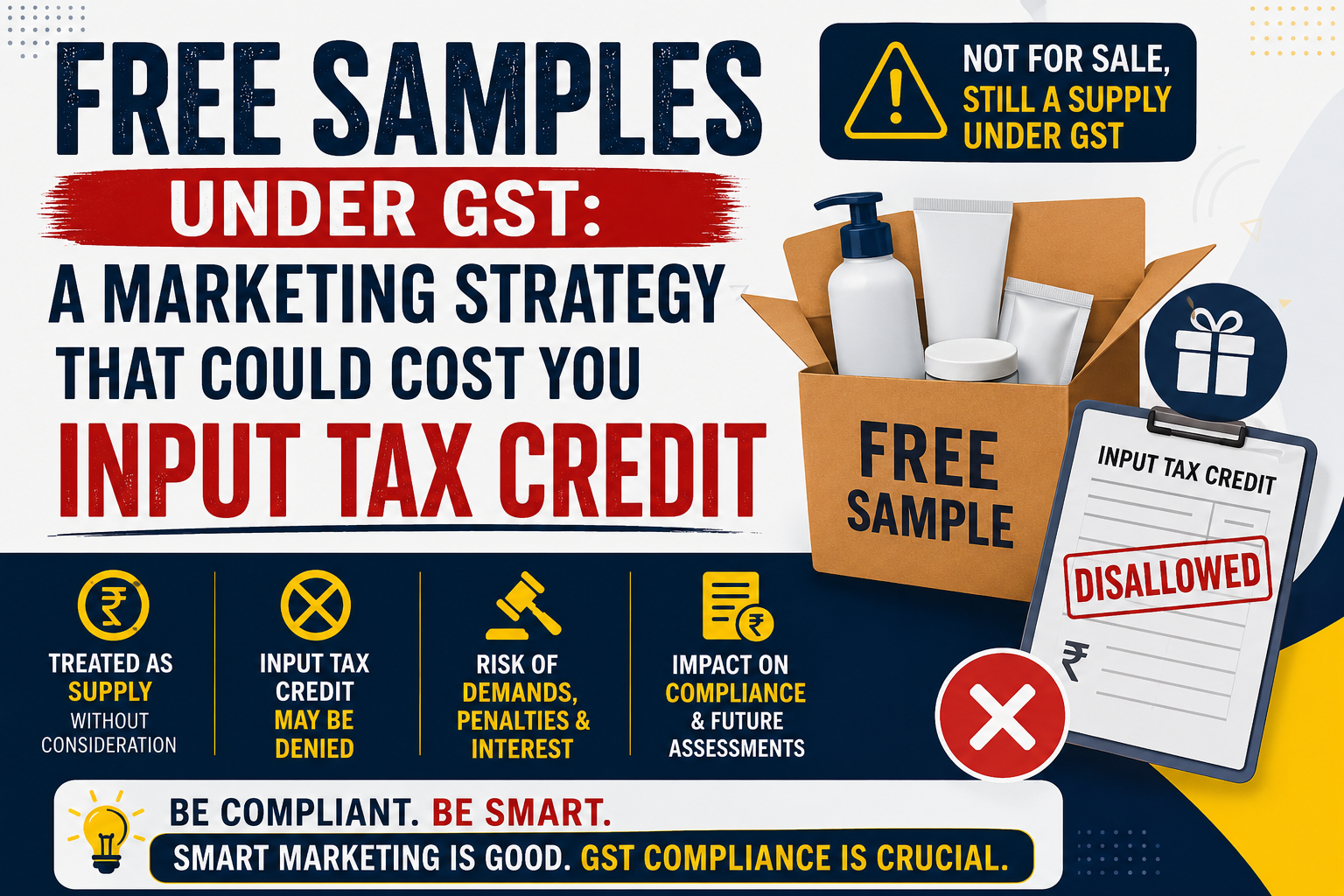
In today's competitive business environment, free samples are one of the most effective marketing tools to build brand awareness, penetrate new markets, and attract potential customers. From pharmaceuticals and FMCG companies to cosmetics and consumer electronics, businesses frequently distribute products without consideration to promote future sales.
However, while free samples may be free for customers, they are certainly not "free" under GST.
A lack of understanding of the GST provisions governing free samples has resulted in numerous disputes involving Input Tax Credit (ITC) reversals, interest, and penalties. Businesses often assume that since no GST is payable on outward supply, the transaction is tax-neutral. Unfortunately, the law says otherwise.
Understanding the GST Position
The GST implications of free samples involve two important provisions of the CGST Act:
#1. Is GST Payable on Free Samples?
As per Section 7(1)(a) of the CGST Act, GST is leviable only on a "supply" made for consideration.
Accordingly, where free samples are distributed without consideration to unrelated persons, such transactions generally do not qualify as a supply, and therefore no outward GST is payable.
However, there is an important exception.
If goods are transferred between distinct persons (such as branches located in different States having separate GST registrations), the transaction falls under Schedule I, which treats certain supplies made without consideration as taxable supplies.
# The Bigger Concern – Input Tax Credit
While businesses may not be liable to pay GST on free samples supplied to unrelated persons, they often overlook the provisions of Section 17(5)(h).
This section specifically blocks ITC on:
* Goods disposed of by way of free samples
* Gifts
* Goods lost, stolen, destroyed or written off
This means that ITC attributable to free samples must be reversed, even though the distribution is undertaken purely for business promotion.
The underlying principle is simple:
GST permits seamless credit only where there is a taxable outward supply. If there is no output tax liability, the corresponding input credit cannot ordinarily be retained.
# Common Areas of Confusion
Businesses frequently encounter practical challenges in distinguishing between various promotional activities.
Some important distinctions include:
Demo Products
Where ownership remains with the business and products are merely displayed or demonstrated, such goods generally do not amount to "free samples". Depending upon facts, ITC may continue to remain available.
Trial Products
If trial products are permanently handed over and are never returned, they effectively become free samples, resulting in ITC reversal under Section 17(5)(h).
Free-of-Cost (FOC) Materials Sent to Job Workers
FOC inputs supplied to job workers for manufacturing do not constitute free samples. Since ownership remains with the principal and the goods are used in manufacturing taxable supplies, ITC generally remains available, subject to compliance with Section 19.
# Interstate Transfers Need Special Attention
One area frequently overlooked during GST audits is the transfer of free samples between branches located in different States.
Although the final distribution to customers may not attract GST, the interstate stock transfer itself is treated as a deemed supply under Schedule I.
Businesses should therefore ensure:
* Proper valuation under Rule 28
* Tax Invoice generation
* Timely payment of applicable IGST
* Correct reporting in GSTR-1 and GSTR-3B
Failure to comply often results in avoidable litigation.
# Practical Compliance Checklist
Before distributing free samples, businesses should ensure:
✅ Identify products intended for free distribution.
✅ Reverse proportionate ITC in the relevant tax period wherever applicable.
✅ Maintain proper inventory movement records.
✅ Document business purpose and approvals.
✅ Review interstate branch transfers separately.
✅ Reconcile accounting entries with GST returns.
# Final Thoughts
Free samples remain an effective business development strategy, but they also represent a significant GST compliance risk if not handled correctly.
With the GST Department increasingly focusing on ITC reconciliations and audit-based verifications, businesses should revisit their internal policies relating to promotional schemes, physician samples, demo products and marketing campaigns.
A proactive compliance approach today can prevent costly litigation tomorrow.
Remember:
A product may be free for your customer—but under GST, it can still come at the cost of your Input Tax Credit.